
When it comes to valuing a company, few methods are as widely respected as the Discounted Cash Flow (DCF) model. By estimating the present value of future cash flows, investors can determine whether a stock is undervalued or overvalued. Understanding DCF helps you move beyond speculation and into rational, data-driven investing.
What is DCF?
Discounted Cash Flow (DCF) is a valuation method that calculates the present value of a company’s expected future cash flows, adjusted by a discount rate. Simply put, it tells you how much a company is worth today, based on how much money it will generate in the future.
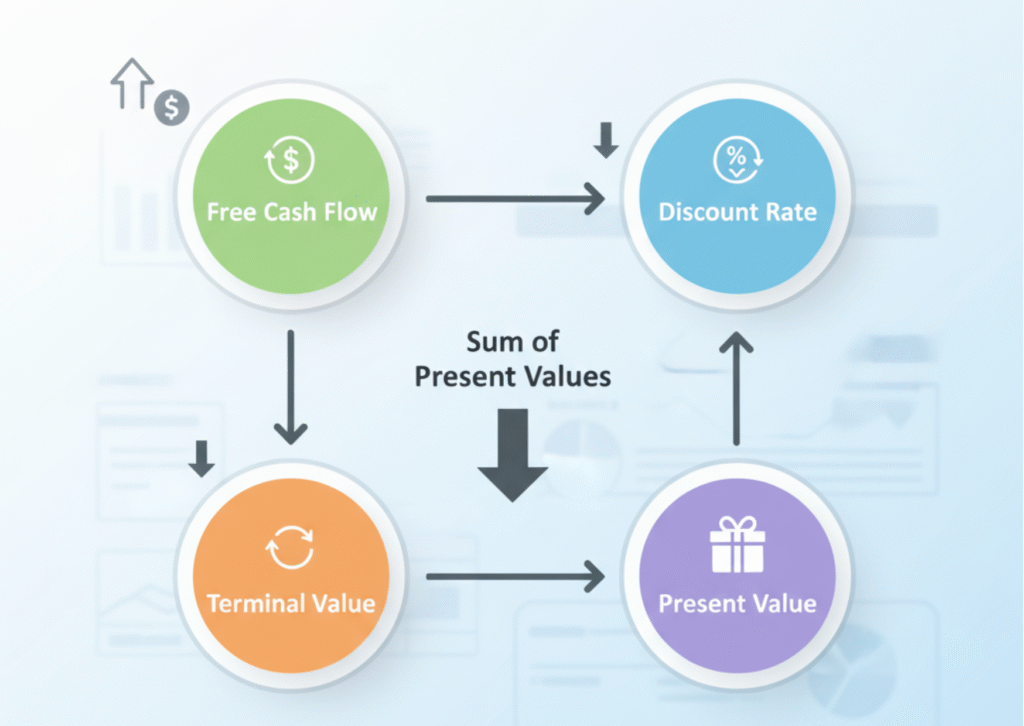
Key Components of DCF Analysis
- Free Cash Flow (FCF)
- The cash a company generates after accounting for capital expenditures.
- Formula: FCF = Operating Cash Flow – Capital Expenditure
- Forecasting Period
- Typically 5–10 years of future cash flows are estimated.
- Terminal Value
- Represents the value of the company beyond the forecast period.
- Two common methods: Gordon Growth Model or Exit Multiple.
- Discount Rate
- Usually based on the company’s Weighted Average Cost of Capital (WACC).
- Accounts for risk and time value of money.
- Present Value Calculation
- Future cash flows + terminal value are discounted back to today’s value.
Steps to Perform a DCF Analysis
- Project the company’s future free cash flows.
- Choose an appropriate discount rate (WACC).
- Calculate the present value of each year’s cash flow.
- Estimate the terminal value.
- Add the discounted cash flows + terminal value = Intrinsic Value.
- Compare with current market price to decide if the stock is undervalued or overvalued.
Why DCF Matters for Investors
- Provides an intrinsic value rather than relying only on market sentiment.
- Helps avoid overpaying for overhyped stocks.
- Encourages long-term thinking rather than short-term speculation.
- Can be adapted for companies, projects, or even startups.
Limitations of DCF
- Accuracy depends heavily on assumptions (growth rates, discount rate).
- Small errors in forecasts can lead to big differences in valuation.
- Not always reliable for companies with unstable or unpredictable cash flows.
Conclusion
The Discounted Cash Flow (DCF) model is one of the most powerful tools in a value investor’s toolkit. While it requires careful assumptions and research, it gives a clear picture of what a company is truly worth.
👉 If you want to learn practical valuation techniques and master tools like DCF, you can join Niveshpath Shala and start your journey toward becoming a smarter investor.